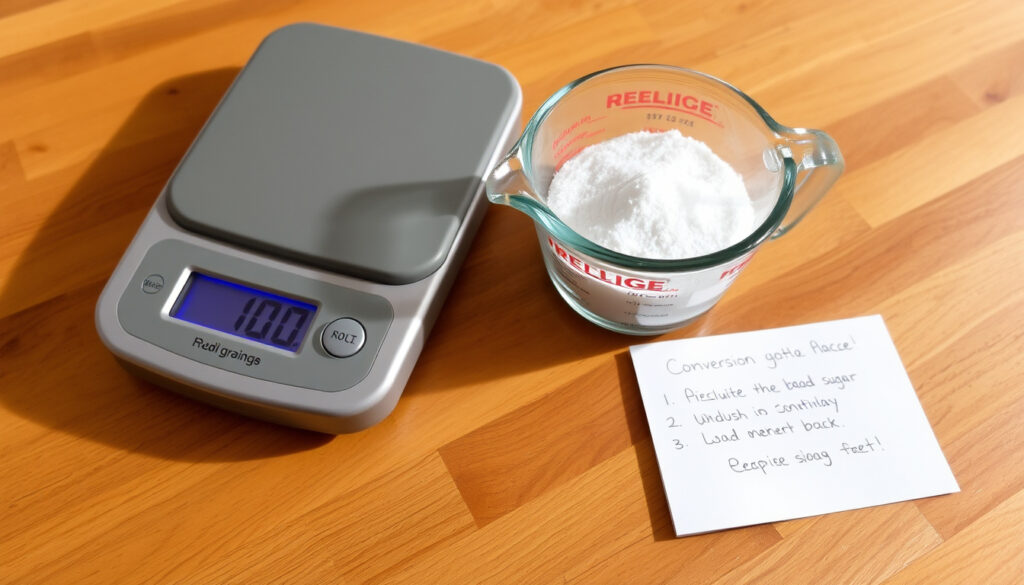
1 cup sugar in grams – Complete conversion guide for bakers
Converting cups to grams for sugar is one of the most common questions in baking, yet the answer changes depending on the type of sugar and how it is measured. Granulated, brown, powdered, and caster sugar all pack differently into a measuring cup, leading to different gram weights. This guide provides clear, source-based conversions for each sugar variety and explains why the numbers sometimes vary.
How Many Grams Are in 1 Cup of Granulated Sugar?
200 g (common) / 201 g (USDA)
220 g (common) / 213 g (USDA)
120 g (US) / 100 g (UK / light)
180 g (UK standard)
- All sugar cup-to-gram conversions depend on three factors: sugar particle size, packing method, and regional cup definition (US vs metric).
- Granulated sugar is the most consistent – nearly all sources agree on 200–201 g per US cup.
- Brown sugar requires packing; a loosely filled cup can be 180 g, while firmly packed can be 220 g or more.
- Powdered sugar is the lightest due to air gaps; sifting can reduce weight further.
- For best baking results, always follow the method (spoon & level, scoop, pack) indicated by the recipe author.
| Sugar type | 1 cup in grams | Notes |
|---|---|---|
| Granulated sugar | 200 g or 215 g | Different measurement references give slightly different values. Charlotte’s Lively Kitchen, Joy of Baking, Doves Farm |
| Caster / superfine sugar | 200 g or 202 g | Also called castor/caster sugar; usually treated like fine white sugar. |
| Brown sugar (light, packed) | 200 g to 218 g | Depends on packing firmness. Annie’s Noms, Joy of Baking, Doves Farm |
| Brown sugar (dark, packed) | 238 g | Darker sugars are denser. Annie’s Noms, Joy of Baking |
| Powdered / icing sugar | 115 g or 120 g | Unsifted. Sifted weight can be lower. |
How Many Grams Are in 1 Cup of Brown Sugar (Packed)?
Brown sugar is the most variable of all sugar types. A loosely filled cup of light brown sugar weighs around 180 g, while a firmly packed cup can reach 220 g or more. Dark brown sugar, which contains more molasses, is denser still: one source lists 238 g per packed cup. The USDA FoodData Central states 213 g for packed brown sugar, while King Arthur Flour uses 200 g. This variation underscores the importance of following the recipe’s instruction on packing.
When a recipe says “packed brown sugar,” press the sugar firmly into the measuring cup until it holds the cup’s shape when turned out. Do not press so hard that the sugar becomes a solid block; a moderate, consistent pressure yields reliable results.
Should brown sugar be packed or loose when measuring?
Most baking recipes that call for brown sugar specify “packed.” If the instruction is absent, assume a firm pack – scoop the sugar into the cup and press down with the back of a spoon until no more sugar can be added without excessive force. Loose brown sugar measures roughly 170–180 g per cup.
1 cup brown sugar unpacked vs packed
The difference can be dramatic: unpacked brown sugar weighs about 170–180 g per cup; packed can exceed 220 g. For a simple rule, aim for the middle: 200 g per cup of packed light brown sugar, and 238 g for dark brown sugar (packed).
How Many Grams Are in 1 Cup of Powdered Sugar (Icing Sugar)?
Powdered sugar, also called icing sugar or confectioners’ sugar, is finely milled and contains a small amount of cornstarch to prevent clumping. Because of the large volume of air between particles, 1 cup (unsifted) typically weighs between 115 g and 120 g. Sifting can reduce the weight to around 110 g or less. Always check whether the recipe expects sifted or unsifted powdered sugar – the difference can affect the sweetness and texture of frostings and glazes.
Unsifted: 1 cup = 120 g. Sifted: 1 cup = 110 g. If a recipe does not specify, use the unsifted weight; if the sugar looks lumpy, sift first and then measure.
How Many Grams Are in 1 Cup of Caster Sugar?
Caster sugar (also called superfine sugar) has crystals smaller than granulated but larger than powdered. Its weight per cup depends on the regional cup definition. In UK recipes, a cup of caster sugar is often listed at 180 g, while US sources give 200 g or 202 g. The difference stems from the UK cup being slightly smaller (approximately 240 ml vs the US 237 ml, but with different packing conventions).
1 cup caster sugar in grams UK
UK baking authorities such as Doves Farm and Hello Fresh use 180 g per cup for caster sugar. If you are converting a UK recipe to grams, use 180 g. For US recipes using US cups, use 200 g – the same as granulated sugar.
Is caster sugar the same as granulated sugar weight?
In US cups, the weight is virtually identical (200–202 g). In UK cups, caster sugar is lighter because the UK cup is slightly smaller and the packing method often differs. Treat them as interchangeable by weight for US recipes, but check the recipe origin.
Why Do Different Sources Give Different Gram Values for 1 Cup of Sugar?
The confusion comes from three factors. First, the US cup is a volume measure (237–240 ml), while grams measure weight. Second, different sugar particle sizes create different packing densities – fine powders settle more densely than coarse granules. Third, authoritative sources use slightly different measuring methods: some scoop directly into the cup, compressing the sugar; others spoon the sugar into the cup and level it, leaving more air.
For granulated sugar, the consensus is 200–201 g per US cup – a variation of less than 0.5% that does not affect most baking. Brown sugar is the only type where the range (180–238 g) is large enough to matter. The King Arthur Flour measurement conversions recommend 200 g for granulated and 213 g for packed brown sugar, while the USDA gives 201 g and 213 g respectively.
How to Accurately Measure 1 Cup of Sugar for Baking
Should I spoon or scoop sugar when measuring?
For granulated, caster, and powdered sugar, the “spoon and level” method is most accurate: use a spoon to fill the measuring cup, then level the top with a straight edge. This prevents compacting. Brown sugar should be packed – press it down firmly with the back of a spoon until the cup is full and level.
What is the best way to measure sugar for consistent results?
Invest in a digital kitchen scale. Weighing in grams eliminates all ambiguity from cup measurements. For reference, here is a timeline of how modern cup measurement became standardised.
A Brief Timeline of Cup Measurement Standardisation
- 1896 – Fanny Farmer’s Boston Cooking School Cookbook standardises the “level cup” measurement in the United States.
- 1950s – The US standard cup is formally defined as 240 ml (8 fluid ounces).
- 2010s – Digital scales become common in home kitchens, reducing reliance on cup-based conversions.
- 2025 – Online conversion tables still disagree by up to 10 g for some sugar types; authoritative guidance remains split.
Certainty vs. Uncertainty in Sugar Cup-to-Gram Conversions
| Established information | Information that remains unclear |
|---|---|
| 1 US cup of granulated sugar weighs approximately 200 g (±2 g). | Exact values differ by source (e.g., King Arthur uses 200 g, USDA uses 201 g). The difference is negligible for most recipes. |
| Brown sugar weight depends heavily on packing – packed vs unpacked can differ by 30–40 g. | Caster sugar weight varies by region: UK cup (≈180 g) vs US cup (≈200 g). |
| Powdered sugar weight is lower due to air – always specify sifted or unsifted. | Altitude and humidity can affect sugar density, but no standard adjustment is published. |
Analysis: Why Sugar Conversion Values Vary and How to Choose
The confusion stems from three factors: the US cup is a volume measure (240 ml), while grams are weight; different sugar particle sizes create different packing densities; and authoritative sources use slightly different measuring methods. For granulated sugar, the consensus is 200–201 g per US cup – a variation within 0.5% that won’t affect most baking. Brown sugar is the trickiest: “packed” is subjective. Always follow your recipe’s guidance; if not specified, use a firm pack (press down until cup is full and level). For powdered sugar, unsifted weight is around 120 g; sifting can reduce it to 110 g or less. The NIST provides background on measuring cup standards, while Britannica offers a broader look at volume measurement.
Sources and Quotations
USDA FoodData Central provides weight per volume for granulated sugar: 1 cup = 201 g.
King Arthur Flour – baking authority – uses 200 g per cup of granulated sugar and advises spoon-and-level.
Doves Farm conversion table shows 200 g granulated sugar per cup, but note the UK cup is different.
What’s Next: Better Baking with Consistent Measurements
Check your recipe’s origin (US vs UK) – the cup size differs slightly. Adopt the spoon-and-level method for granulated and powdered sugar; pack brown sugar. Use a kitchen scale for critical recipes (macarons, breads) where 5 g matters. Bookmark a single trustworthy conversion chart to avoid confusion. For more ingredient insights, see What Does Matcha Taste Like – Umami, Bitterness and Flavor Guide and Protein Powder for Weight Loss – Best UK Picks and Reviews.
Frequently Asked Questions
1 cup of flour in grams?
All-purpose flour: 1 cup = 120–125 g (spoon and level). Bread flour: 127–130 g.
1 cup butter in grams?
1 cup of butter = 227 g (standard US stick butter).
1 cup milk in grams?
1 cup of milk = 244 g (whole milk).
1 cup of sugar in grams for brown sugar vs white?
White granulated: ~200 g; Brown packed: ~220 g.
1/2 cup sugar in grams?
Half a cup of granulated sugar is about 100 g; 1/2 cup brown sugar packed is ~110 g.
How many grams in 1/4 cup of sugar?
1/4 cup granulated sugar = 50 g; 1/4 cup brown sugar packed = ~55 g.
More related posts
 Phoenix Suns vs Golden State Warriors Match Player Stats – Warriors Edge Suns 119-116
 Kristen Bell Movies and TV Shows – Full List and Where to Watch
 Dave’s Hot Chicken Manchester – Locations, Hours, Menu Guide
 NCIS Tony and Ziva – Guide to Episodes Cast Streaming After Cancellation
 Cast of All of Us Are Dead – Complete Actors and Roles Guide
 Cast of Riviera (TV Series) – Every Major Actor and Role
 Benefits of Vitamin D – Proven Health Effects from Studies
 How to Stop Feeling Sick – Fast Home Remedies That Work